Metal Guitar for Beginners: The Complete Guide to Get Good, Fast

So you've got the basics down. Open chords, a little strumming, maybe you've even worked your way through a power ballad or two. Now you're ready to unleash the metal within.
Welcome to metal guitar, where the gain is cranked, the chugs are heavy, and honestly, it's the best genre out there. That's not biased talking, that's just passion.
I'm going to walk you through everything you need to get started playing metal guitar the right way. We'll build a solid foundation together so you can learn your favorite riffs faster, and by the time you're done reading, you'll have everything you need to start sounding metal without needing a degree in music theory.
Learn Power Chords, First

Power chords are the easiest part of learning metal guitar, and yet they're the foundation on which almost every subgenre of rock and metal is built. And they're powerful...I guess the pun is intended.
Here's the best part. Once you know one power chord, you basically know them all, and I'm going to show you the simplest way to learn them.
A power chord is just two notes. The root, which is your starting note, and the fifth, which sits five notes up from the root. You play them on two neighboring strings, and the easiest way to remember the shape is this: the fifth is always one string up and two frets over from the root.
Here are a few examples:
G Power Chord
Played on the 3rd fret of the E string and 5th fret of the A string.

D Power Chord
Played on the 5th fret of the A string and 7th fret of the D string.

E Power Chord
Played with the open E string and 2nd fret of the A string.

One Simple Shape = Every Power Chord
Here's where it gets fun. That same shape works anywhere on the E, A, and D strings. The root note you start on is what determines the chord's name. Which means you've basically just learned every power chord there is.
With just this one shape, you can already play a ton of metal songs. Power chords really are the lifeblood of metal rhythm guitar.
There's a bit of music theory hiding behind why that shape works, and we'll touch on it later. For now, just focus on getting comfortable moving that shape around the neck.
Power chords are only half the story, though. There's one more piece that gives metal its signature chugging sound, and that's palm muting.
Palm Muting: The Secret to the Chug
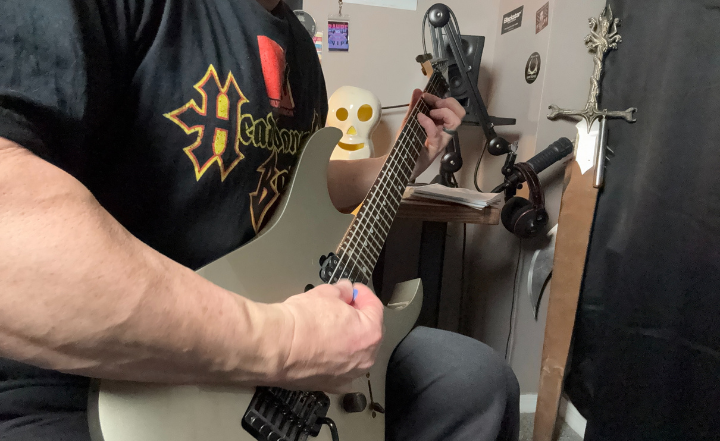
Think back to the first time metal really grabbed you, that heavy, chunky sound that made you want to play it instead of just listen to it. For me, that moment was the late 80s, discovering Master of Puppets and ...And Justice for All for the first time. That's the magic of palm muting.
Palm muting is when you lightly rest the palm of your picking hand across the bridge of the guitar. It partially mutes the strings and gives you that tight, chugging tone that defines the genre.
A great place to hear it in action is the intro to "Disposable Heroes," though honestly, you could point to almost any metal song from any era and find palm muting somewhere in there.
Most often, you'll palm mute on an open string, usually the low E. But there's more than one way to use it. You can palm mute a single note for a tight chug, mute full power chords for a chunkier controlled sound, or combine muted notes with ringing power chords, which is really where riffs start coming alive and where you begin writing your own.
How hard you mute changes the feel entirely. Muting aggressively gives you a tighter, sharper attack, which works great for fast, precise riffs. Just be careful not to press too hard, or you'll pull the strings out of tune. Muting lightly gives you a looser, more open feel that suits a groovier riff.
Play around with both. Listen to how each one changes the tone and intensity of what you're playing.
Single-Note Riffs: The Backbone of Metal
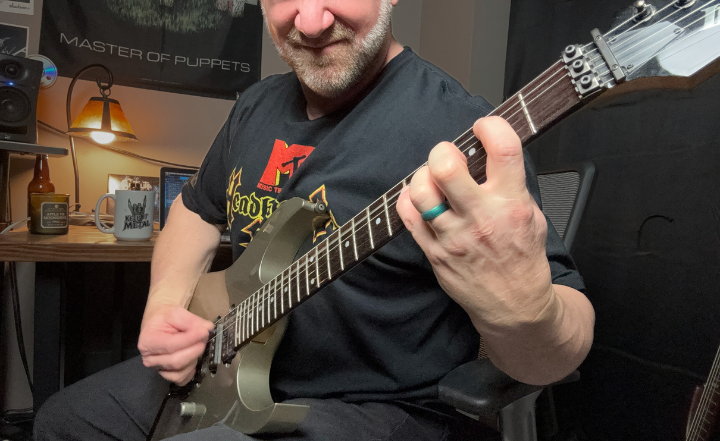
Melody is everything in music, no matter the genre. And as chaotic and heavy as metal can get, it's still that one riff stuck in your head that won't let go. Those iconic hooks almost always come from single-note riffs.
You've probably already learned a few without realizing it. Mine was picking out Sabbath's Iron Man on a single string. That's the moment the floodgates opened for me.
One of the best ways to understand riffs is through basic scales, and no, you don't need to be a theory expert to use them. The scale that's practically the lifeblood of metal is the E minor scale.

Here's what's worth knowing about it. It starts on an E note and ends on an E note, and you don't skip a fret between the 2nd and 3rd notes or the 5th and 6th notes. The best part is that the pattern never changes. Every minor scale follows the same structure; the only thing that changes is where you start it.
That one concept alone will get your fingers moving across the fretboard and help you learn riffs a lot faster. Just remember, you're not locked into only playing scale notes. The last thing you want is to sound like you're running scales instead of playing music. Think of the scale as your foundation, something you build your own style on top of.
A few legendary riffs worth knowing if you don't already:
- Master of Puppets, Metallica
- Iron Man, Black Sabbath
- Painkiller, Judas Priest
- Seek and Destroy, Metallica
- Blacklist, Exodus
- Holy Wars, Megadeth
- Kiss of Death, Dokken
Notice something about all of them. Everyone blends single note riffs with palm muting and power chords. That combination is what makes metal sound like metal. Once you start mixing all three together yourself, that's the moment you go from learning metal to actually playing it.
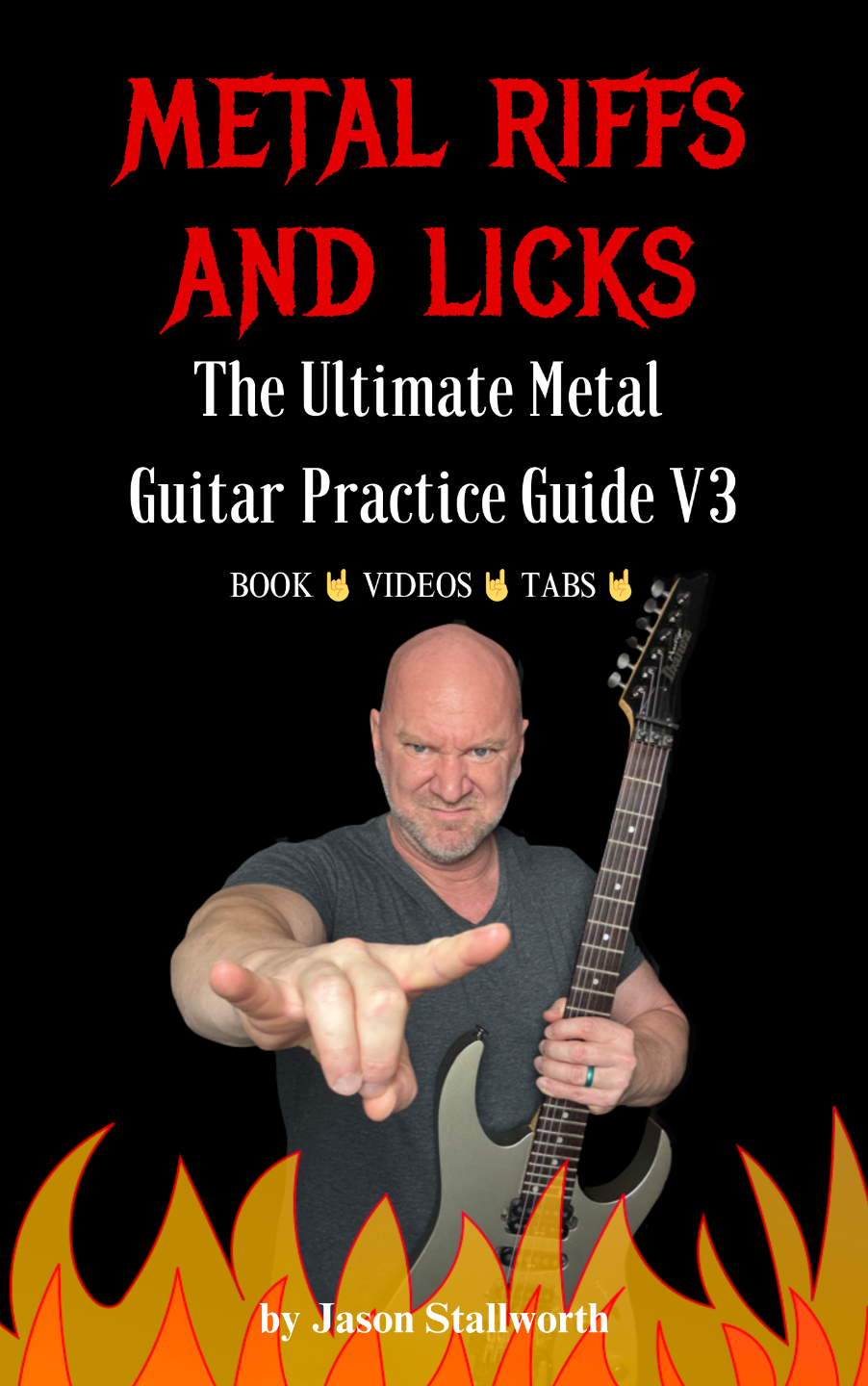
If you want a simple, structured starting point for building out your metal foundation, I put together a free guide called Metal Riffs and Licks that walks you through exactly this kind of thing.
🤘 Get my FREE Metal Riff and Licks Ultimate Lesson Guide Here
Down-Picking vs. Alternate Picking
Both down-picking and alternate picking are essential techniques for metal guitar, and each one gives you a different sound and feel. Learning both early makes your life a lot easier down the road.
I spent my entire first year down-picking exclusively, and by the time I finally started working on alternate picking, it felt like relearning guitar from scratch. Save yourself that detour and start building both from the beginning.
Down-picking means picking downward only, starting above the note each time. Alternate picking means alternating up and down strokes, striking the note both ways. Down-picking tends to feel tighter, chunkier, and more aggressive, think Master of Puppets. Alternate picking feels faster and smoother, and it's what you'll lean on for shredding and speed riffs.
Both matter equally in metal. Most beginners naturally gravitate toward down-picking at first, and that's completely fine, just don't neglect alternate picking while you're at it.
Try applying both to what you've already learned. Play a simple chugging riff with only down-picking, then run it again with alternate picking. Practice the E minor scale both ways, too. Try palm muting while alternating your pick strokes for a tighter feel. The sooner both techniques feel natural, the faster and tighter your playing becomes.
Music Theory: A Tool, Not a Rule
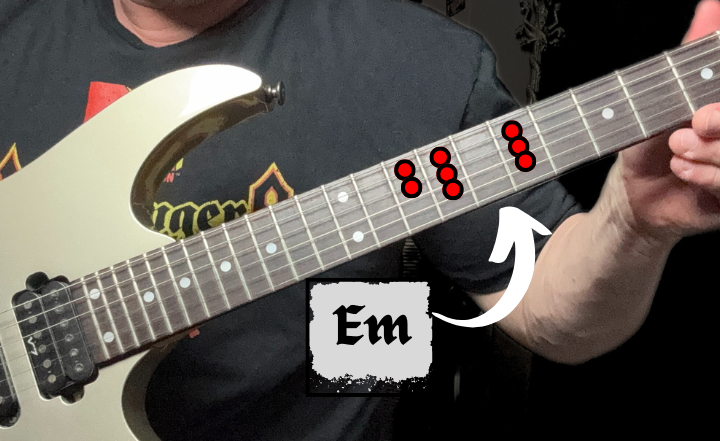
Here's the first thing I want you to understand about music theory. It's not a set of rules you have to obey. It's a tool that serves you, not the other way around, so don't overthink it.
You don't need a deep theory background to play metal. Some players love diving into theory, others prefer to learn entirely by ear and feel. Both paths are completely valid. That said, knowing the basics will help you learn faster and take some of the guesswork out of your playing.
You actually already know more theory than you realize. Go back to that E minor scale structure we covered. Because you understand that pattern, you now automatically understand every minor scale there is. It really is that simple.
Since the scale starts and ends on E, you can keep extending it up the fretboard from the higher E. That's how you start connecting scale shapes across the whole neck, and the more you explore it, the more comfortable you'll get with where everything sits.
One important thing to keep in mind. Playing metal was never about running scales up and down the neck. Scales are a foundation, a way to understand which notes fit within a key like E minor. The real goal is using them creatively inside your riffs and solos, not playing them mechanically.
Every key also has a set of chords that naturally live inside it. In the key of E minor, that's E minor, G major, A minor, B minor, C major, and D major, all built from the same six notes as the E minor scale. The one outlier is F sharp, the second note in the scale, which doesn't show up in the standard chord progression. I'll go deeper into that in a future post.
Here's the real takeaway, though. Just because a theory-concept exists doesn't mean you have to follow it to the letter. Metal often bends the rules on purpose to get a heavier, darker sound.
So experiment. Play some chords inside the key of E minor, then start weaving in single-note riffs and palm muting. Once that feels comfortable, step outside the key entirely. Throw in a note or chord that doesn't technically belong. If it sounds cool, keep going with it. If it doesn't, adjust and try again. That's trusting your ear, and it's one of the fastest ways to grow as a metal guitarist.
Now Go Forth and Make Some Metal
You've just laid the foundation for metal guitar. Power chords give you the building blocks for heavy riffs and massive progressions. Palm muting is the secret behind that tight, chugging tone. Single note riffs are the melodic backbone that makes songs instantly recognizable. Down-picking and alternate picking are the two techniques that tighten up your playing and build your speed. And a little bit of theory helps you understand what you're playing without ever boxing you in.
At this point, you've got everything you need to start playing real metal songs and even start writing riffs of your own.
A few things to focus on from here. Practice a little bit every day, even ten or fifteen focused minutes on palm muting, picking, and power chords will move your playing forward fast. Pick a metal song you love, something not too crazy, and apply what you just learned here. Start experimenting with your own riffs by mixing power chords, single notes, and palm muting into something new. Don't chase perfection, just play.
And most importantly, have fun with it. Metal was never about being flawless. It's about energy, passion, and raw power.
If you're ready to take this further with a real, structured path instead of piecing things together on your own, that's exactly what I built the Jason Stallworth Guitar Academy for. Come check out what's inside.
This is just the beginning. Keep playing, keep learning, and keep pushing yourself forward. Metal is all about evolution, so embrace the journey.
Become the Metal Guitarist You Were Meant to Be
A clear, structured path to tighter riffs, cleaner technique, and real confidence, so you're never guessing what to practice next.
Jason Stallworth